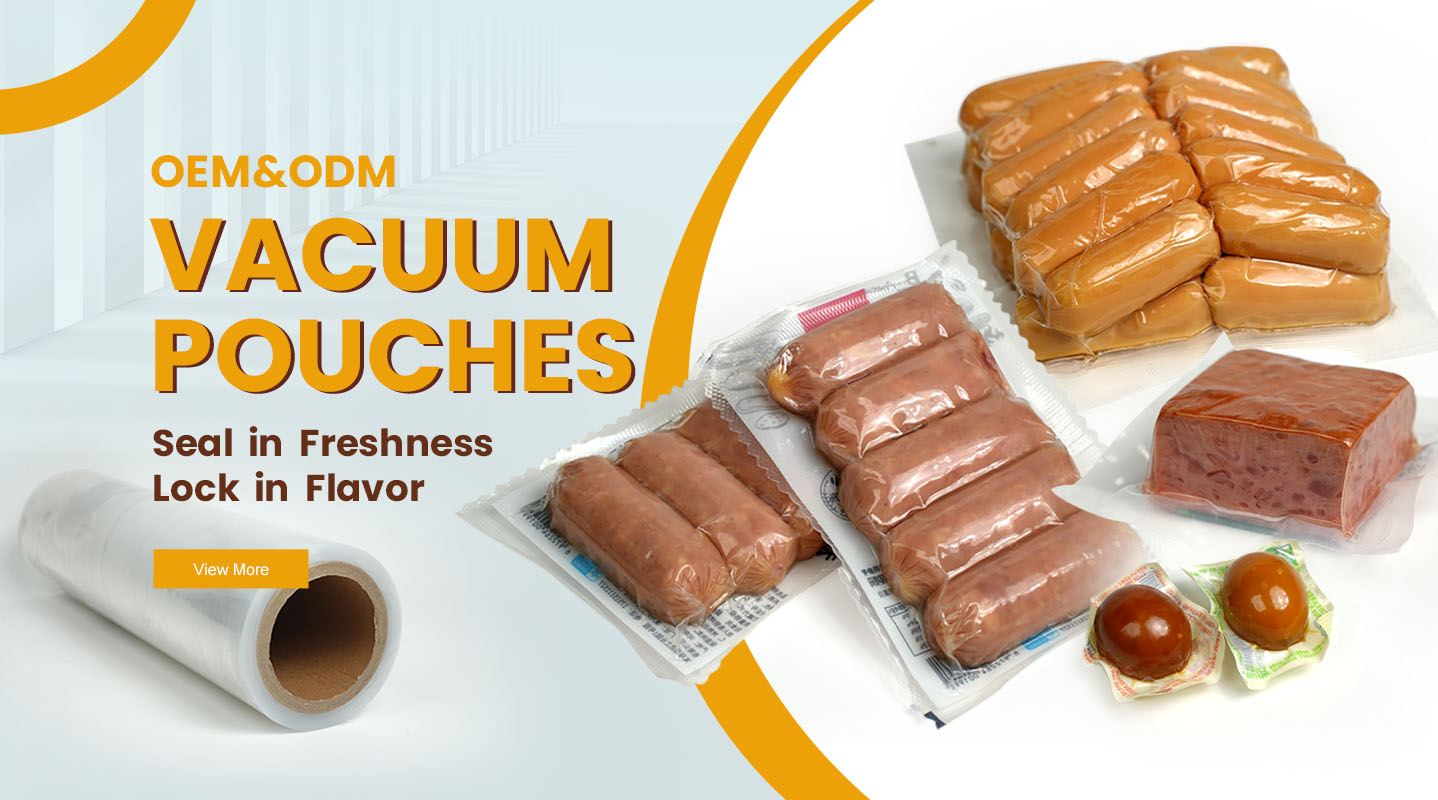
Choosing the right packaging film is essential for preserving sausage quality, extending shelf life, and maintaining safety during storage and transport. Improper film selection can lead to spoilage, discoloration, and package deformation, affecting both product appearance and customer trust. Sausage Packaging Film plays a critical role in protecting meat from oxygen, moisture, and microbial contamination, while supporting modern vacuum packaging processes.
High-quality sausage packaging relies on films with superior barrier properties. Oxygen, moisture, and light penetration all accelerate spoilage and lipid oxidation in sausages. Films with low oxygen transmission rate (OTR) and low water vapor transmission rate (WVTR) prevent oxidation and maintain firmness.
Industry research shows that sausages packaged with films having an OTR below 12 cc/m²/24h and WVTR below 3 g/m²/24h maintain freshness up to 40% longer than standard films. Sausage Vacuum Packaging Film with multilayer barrier construction minimizes gas permeation, keeping the product tightly sealed and safe for distribution.
Seal integrity is a major factor in sausage packaging performance. Weak seals or inconsistent heat application can lead to air ingress, causing the package to appear loose and reducing shelf life. Sausage packaging films need adequate heat-seal strength to withstand handling, transport, and stacking without breaking or loosening.
Elasticity is another important factor. Sausages often have irregular shapes, and films must conform closely without tearing. Materials with balanced tensile strength and elongation properties ensure that vacuum packaging molds effectively around each sausage, providing consistent tightness and protection throughout cold storage.
Different films provide unique advantages depending on sausage type and storage conditions. Common options include polyethylene-based films, polyamide blends, and multilayer coextruded films. Each material contributes specific benefits:
Polyamide (PA) Layers enhance puncture resistance for sausages with sharp ends or casings.
Polyethylene (PE) Layers provide excellent sealability and flexibility.
Barrier Layers such as EVOH reduce gas permeation, maintaining vacuum integrity.
The combination of these layers allows manufacturers to optimize both protective function and packaging efficiency. Sausage film supplier quality standards typically require minimum tensile strength of 30 MPa and seal strength exceeding 15 N/15 mm to handle commercial packaging demands.
Vacuum-sealed sausages are sensitive to temperature fluctuations. If stored improperly, trapped gases expand, weakening seals and creating loose packages. Films suitable for sausage vacuum packaging should maintain dimensional stability across a wide temperature range, from -25°C for frozen products to 15°C for chilled distribution.
Thermal stability also affects shrinkage. Films with high shrinkage resistance reduce deformation during heat sealing or reheating, preventing the film from stretching or wrinkling. This ensures a uniform appearance that retains product appeal on retail shelves.
Sausages are prone to bacterial growth, which can produce gases that compromise vacuum integrity. Using films with high barrier performance and controlled oxygen permeability helps limit microbial respiration and maintains vacuum-tight packaging. Sausage packaging films with antimicrobial coating layers can further reduce spoilage risks, enhancing food safety.
Additionally, films should resist chemical interactions with fat and additives. Compatibility with oils and spices prevents discoloration and maintains flavor integrity over storage periods. Proper film selection safeguards both quality and safety for end users.
Packaging films must endure mechanical stress during production, transport, and retail handling. Puncture resistance, tear strength, and elongation are critical to prevent accidental breaches or loosening. For high-speed production lines, films with consistent thickness and mechanical performance reduce machine jams and defective packs.
Stacking and palletizing also stress packaging. Films that resist deformation under load maintain product shape and vacuum integrity, ensuring sausages arrive at retail or processing centers without compromise.
Modern sausage packaging films often feature multilayer constructions combining PA, PE, EVOH, and PET layers. These films deliver:
Superior gas barrier properties
Enhanced seal strength and elasticity
Resistance to puncture and handling stress
Dimensional stability across temperature variations
Using such advanced films allows manufacturers to meet strict shelf-life requirements, regulatory standards, and quality expectations. Sausage vacuum packaging film with these properties ensures consistent performance and product integrity throughout the supply chain.
Choosing a reliable sausage film supplier is crucial. Experienced suppliers provide not only high-quality films but also technical guidance for production and packaging optimization. They assist with film selection based on sausage type, storage conditions, and transportation requirements.
JINBORUN, for example, offers extensive support in evaluating barrier properties, heat-sealing conditions, and film thickness to match specific sausage products. Their technical teams help implement production protocols that maximize film performance, reduce package loosening, and extend shelf life.
Effective sausage packaging depends on selecting films that combine strong barrier properties, heat-seal reliability, elasticity, and chemical compatibility. Films designed for vacuum applications reduce air ingress, control microbial growth, and preserve product appearance. By choosing high-performance sausage packaging film from a knowledgeable supplier, manufacturers ensure tight, consistent