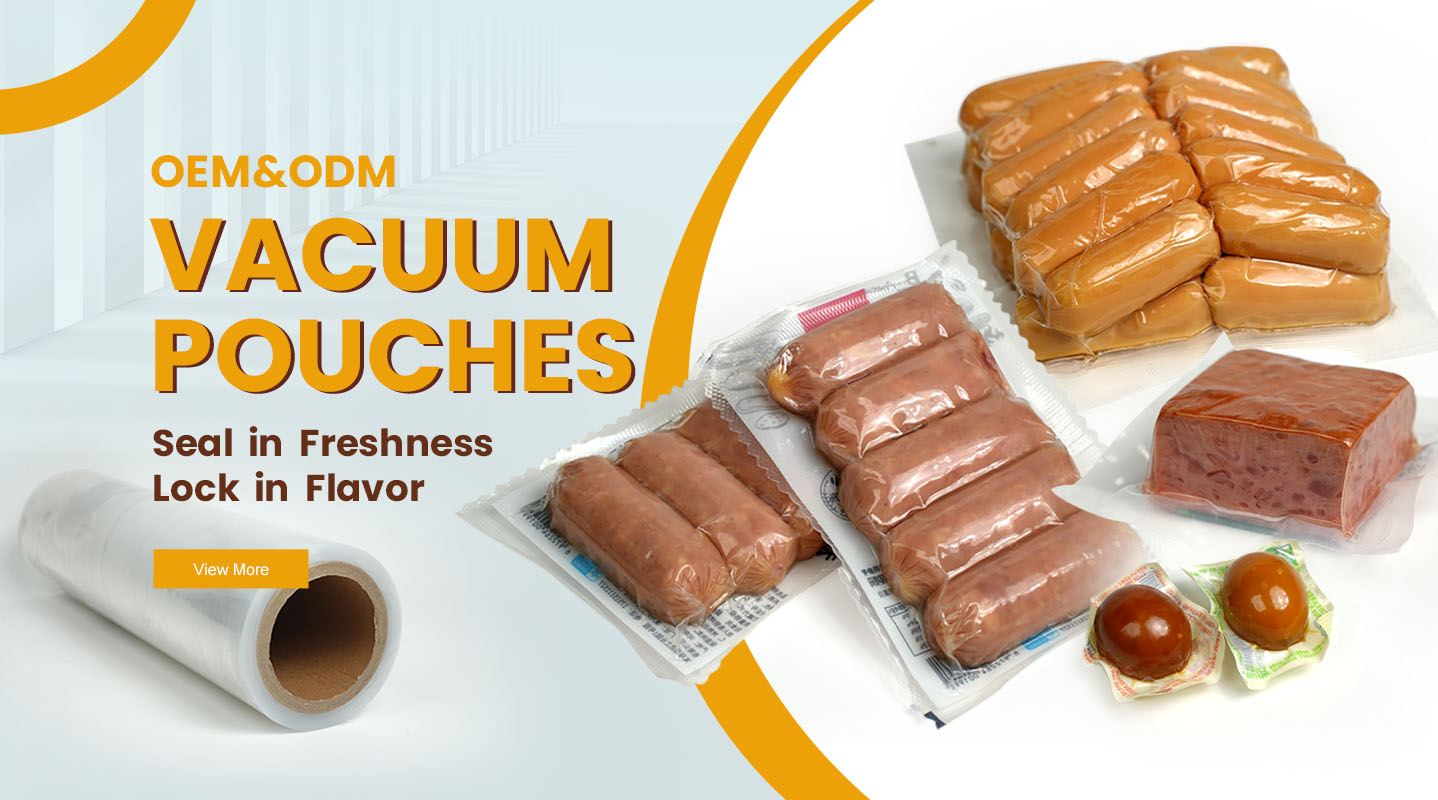
Vacuum Pouch leakage is one of the most common problems in food packaging. The package may look tight after sealing, but air can return after storage, freezing, transport, or shelf display. For meat, seafood, sausage, nuts, frozen food, and prepared meals, this problem can affect appearance, freshness, odor control, and customer confidence.
For food processors, leakage is not only a packaging defect. It can lead to product rework, higher scrap rates, delayed shipment, and complaints after delivery. That is why the cause should be checked from the full packaging process, not only from the pouch itself.
Every vacuum pouch has a suitable sealing temperature range. When the temperature is too low, the inner sealing layer may not fully bond. When it is too high, the seal area may become weak, burned, wrinkled, or brittle. Both situations can lead to air return after the product is packed.
This is especially important for food vacuum pouches used with meat or seafood, because moisture, oil, protein residue, or small particles can stay near the seal area. Even a small amount of contamination can prevent the seal from closing evenly.
JINBORUN designs vacuum pouches and Food Packaging Films according to product type, sealing method, and storage conditions. For stable sealing, the pouch structure should match the packing machine, sealing pressure, sealing time, and actual food condition.
Wet products are more difficult to seal than dry products. Seafood, fresh meat, marinated food, and cooked food often release liquid during packing. If liquid reaches the sealing area, it can create tiny channels inside the seal. These channels may not be visible at first, but they can become leakage points during vacuum storage.
The U.S. Department of Agriculture explains that vacuum packaging removes air from the package, which helps reduce oxidation and slows quality loss under proper storage conditions. However, the package must remain sealed to keep this protection working. Once air returns, the vacuum effect is reduced and the product may lose its expected appearance and freshness.
For wet food, the pouch should have strong sealability and good resistance to contamination at the seal area. Operators should also keep enough clean space above the product to form a reliable seal.
Some leakage problems do not come from the seal. They come from tiny punctures on the pouch body. Bone-in meat, frozen fish, crab shells, hard sausage edges, and frozen product corners can press against the film during vacuum packing. After air is removed, the pouch tightly wraps around the product, increasing contact pressure.
During cold storage or transport, the package may be stacked, dropped, squeezed, or rubbed against cartons. A small puncture may slowly allow air to enter the pouch. This kind of vacuum pouch leakage can be hard to detect immediately because the defect may appear hours or days after packing.
For products with sharp or irregular shapes, pouch thickness, material structure, and puncture resistance should be confirmed before bulk ordering. JINBORUN can adjust vacuum pouch structures for different food applications, helping reduce puncture risk during storage and distribution.
Vacuum pouches used for frozen food must remain flexible at low temperature. Some pouch structures become harder after freezing, which makes them more likely to crack at corners, folds, and sealed edges. A pouch that performs well at room temperature may fail after freezing and handling.
The FDA states that food stored at 0°F or -18°C can remain safe when properly handled, although quality may decline over time. Packaging plays an important role in protecting that quality because it must resist moisture loss, freezer damage, and physical stress.
For frozen meat, seafood, and prepared food, testing should include low-temperature storage and transport simulation. This helps confirm whether the pouch can remain sealed after freezing, stacking, and movement.
Stable pouch quality depends on film consistency. If the film has thin spots, uneven layers, or weak sealing areas, these defects may become leakage points under vacuum pressure. This is why thickness control during film production matters.
A reliable vacuum pouch supplier should control raw materials, extrusion conditions, film thickness, sealing performance, bag making accuracy, and final inspection. Good-looking pouches are not enough. The structure must perform consistently across the whole batch.
| Leakage cause | Common sign | What should be checked |
|---|---|---|
| Low sealing temperature | Seal opens easily | Temperature and sealing time |
| Liquid in seal area | Air returns slowly | Product filling height |
| Sharp food edges | Small punctures | Film thickness and strength |
| Freezing stress | Cracks near corners | Low-temperature flexibility |
| Uneven film | Random leakage | Thickness consistency |
| Poor bag making | Weak side seals | Heat seal accuracy |
Vacuum packaging machines must be adjusted according to pouch size, product type, and material structure. Too much vacuum pressure may increase stress on sharp products. Too little sealing pressure may create weak seals. Wrong sealing bar alignment can cause partial sealing, especially on wider bags.
For automatic or semi-automatic packing lines, repeated leakage may come from unstable machine settings rather than the pouch material alone. Before mass production, sample pouches should be tested on the actual machine with real products, real filling weight, and real storage conditions.
This step is especially important when developing a Customized Vacuum Pouch, because custom size, thickness, structure, and sealing layer may all influence the packing result.
Even when sealing is correct, poor handling can still cause leakage. Vacuum pouches should not be dragged across rough surfaces, overpacked into cartons, squeezed by sharp frozen products, or stacked beyond carton strength. For cold-chain shipments, temperature fluctuation can also increase package stress.
Food packaging research has shown that oxygen exposure can affect meat color, flavor stability, and lipid oxidation. Once vacuum packaging loses tightness, oxygen can enter the pack and reduce the value of the original packaging design.
JINBORUN helps customers review application conditions before production, including product shape, storage temperature, pouch size, film structure, sealing method, and transport environment. This makes it easier to find the right balance between strength, sealing, barrier performance, and cost.
Vacuum pouch leakage after sealing usually comes from a combination of material, sealing, product condition, machine settings, and handling. Solving the problem requires a complete review instead of changing only one factor.
JINBORUN manufactures vacuum pouches and food packaging films for meat, seafood, sausage, frozen food, nuts, and prepared food applications. By focusing on material structure, sealing performance, puncture resistance, thickness consistency, and application testing, JINBORUN helps reduce air return, broken packs, and quality complaints during food storage and shipment.
A vacuum pouch should protect the product from packing line to delivery. When the pouch structure and packaging process are properly matched, leakage becomes easier to control, product freshness is better protected, and packaging performance becomes more reliable across repeat orders.