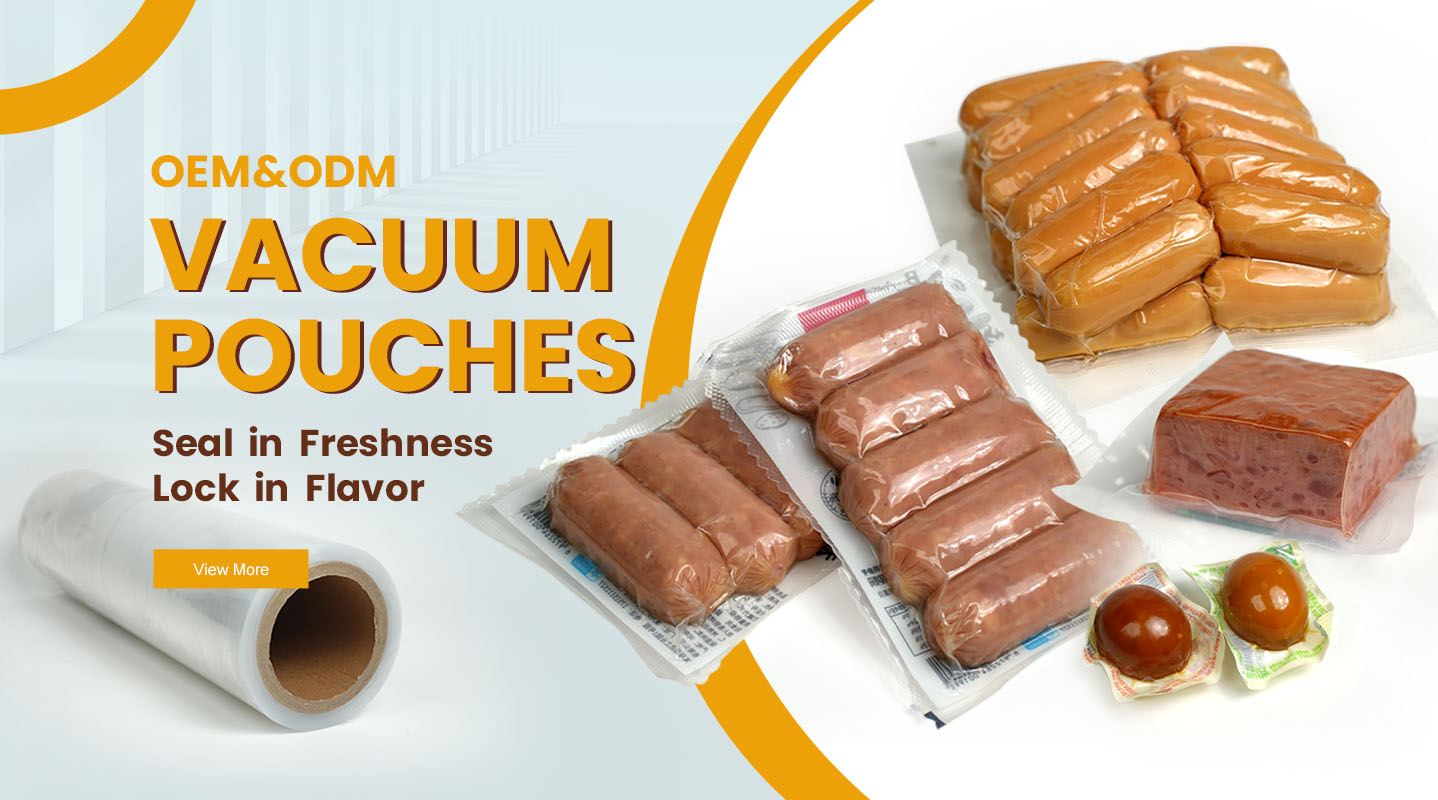
High-performance Meat Packaging Film balances food safety, shelf life, visual appeal, and machinability. Below is a practical overview of the plastics and functional layers commonly engineered into films for fresh red meat, poultry, and processed products. The focus reflects the portfolio typical of professional film manufacturers that supply stretch wrap, shrink bags, Vacuum Pouches, thermoforming webs, and lidding films for case-ready and bulk formats.
Polyethylene is the dominant sealant and stretch layer due to softness, seal strength, and low cost.
LDPE provides softness and strong heat sealing for pouches and lidding. It resists pinholing and delivers good clarity for display cases.
LLDPE improves toughness and stretch for bone-in cuts and high-speed wrapping. Metallocene grades add puncture resistance and a broader sealing window that reduces leakers on form-fill-seal lines.
HDPE lowers water vapor transmission and adds stiffness for top webs in thermoforming where shape retention is needed.
Polypropylene delivers clarity, stiffness, and high temperature resistance.
Used as a print or abuse layer in lidding films to protect ink and graphics.
Oriented polypropylene can improve gloss and scuff resistance where premium presentation matters.
Polyamide, often referred to as nylon, is the workhorse for puncture resistance and moderate gas barrier.
PA6 and PA66 are used in top and bottom webs for thermoformed packs and in shrink bags to prevent bone punctures.
Blends can be tuned for stiffness or softness depending on the forming depth and the shrink curve required.
Polyester is valued for optics, dimensional stability, and strength.
PET acts as a print carrier and abuse layer in lidding films and top webs.
Recyclable PET structures are increasingly used with peelable PE sealants for modified atmosphere trays.
Ethylene vinyl alcohol is the primary transparent oxygen barrier for fresh and cooked meats.
EVOH is coextruded near the center of the film to limit moisture pickup that reduces barrier performance.
Barrier levels are tailored by adjusting ethylene content and layer thickness to meet specific shelf life targets.
PVDC delivers very low oxygen and moisture transmission and is used in shrink bags and some pouches.
Often applied as a coating or coextruded layer when maximum shelf life is required for smoked or cooked meats.
Many plants are transitioning toward EVOH where regulatory and sustainability goals favor chlorine-free structures.
Functional tie resins bond dissimilar polymers such as PE to EVOH or PA.
These layers are essential to multi-layer integrity during forming, sealing, and distribution.
| Format | Typical Layer Stack | Key Strengths | Common Meat Applications |
|---|---|---|---|
| Stretch overwrap | LLDPE or metallocene LLDPE single or multilayer | High clarity, stretch, anti-fog options | Case-ready trays for fresh beef, pork, poultry |
| Shrink bag | PA and PE with EVOH or PVDC barrier | Tight shrink, puncture resistance, strong seals | Bone-in primals, smoked and cooked products |
| Vacuum pouch | PA or PET outside, EVOH barrier, PE sealant | Robust abuse resistance, good optics | Sliced deli meats, cured hams, marinated cuts |
| Thermoform bottom web | PA or PA-PE blends with EVOH barrier | Deep draw, puncture resistance, machinability | Fresh and processed meats on roll-stock |
| Thermoform top web or lidding | PET or PP outside, EVOH barrier, PE sealant | Print quality, peel control, high barrier | MAP trays with gas flush for steaks and poultry |
Oxygen barrier measured by OTR directly impacts color retention and microbial growth. EVOH or PVDC layers are tuned to the target shelf life for chilled distribution.
Moisture barrier measured by WVTR is important for frozen logistics and dry cured meats. HDPE and PVDC help reduce moisture loss or gain.
Puncture and tear resistance protects packs during bone-in handling and transport. PA content is increased for rib and shank cuts where edges are sharp.
Seal integrity depends on the sealant polymer and heat-seal window. Metallocene LLDPE improves hot-tack and reduces leakers at high line speeds.
Optics such as gloss and haze influence consumer appeal. PET and oriented PP enhance shelf presentation.
Formability and shrink must match equipment. Bottom webs require controlled draw without thinning while shrink bags need balanced biaxial shrink for tight presentation.
Food contact compliance requires approved resins and coatings with validated migration performance for the target market.
Printability is driven by surface energy and outer-layer selection. PET and PP provide sharper graphics for branding and date codes.
Anti-fog prevents condensation that clouds display visibility in refrigerated cases. Formulated within PE or applied as a coating on lidding films.
Slip and antiblock ensure smooth film unwind and accurate web tracking on high-speed lines while maintaining seal strength.
Antimicrobial and odor control technologies are sometimes integrated to inhibit surface growth or manage smoke aromas in processed meats.
Peelable systems allow clean, consistent opening without delamination of barrier layers.
Ink and lacquer systems on PET or PP enhance scuff resistance for transport and handling.
Requires high oxygen barrier to maintain bloom inside a modified atmosphere pack or to maintain color stability in vacuum skin packs.
Lidding with PET outside, EVOH barrier, and PE sealant is common. Bottom webs use PA blends for formability and resistance to bone edges.
Needs robust puncture resistance and strong seals for purge management.
Shrink bags with PA and EVOH are widely used for whole birds. Thermoformed packs for parts favor PA-rich bottom webs with metallocene PE sealants.
Barrier targets vary by water activity, smoke level, and salt content.
PET or PP print layers with EVOH barrier protect graphics through retort or hot fill where required, paired with PE sealants engineered for peel control.
Lower oxygen and moisture transmission are important over long storage.
HDPE blends in the sealant layer improve moisture barrier and stiffness for stackability without sacrificing impact strength.
High PA content or dedicated bone-guard patches prevent puncture during transport.
Shrink bags with balanced biaxial shrink deliver tight presentation while resisting abrasion.
Bottom web thickness is selected to support draw depth and maintain barrier continuity through corners.
Top web stiffness needs to resist flutter and bridge across tray flanges for accurate sealing.
Peel forces are engineered for consumer opening without tearing the tray flange or delaminating printed layers.
Gas composition for MAP interacts with film barrier. High oxygen mixes for red meat require very low OTR to maintain color and reduce metmyoglobin formation.
Mono-material PE or PP structures reduce complexity and support store drop-off or emerging curbside streams where available. EVOH content is kept below design thresholds to maintain recyclability guidelines.
Recycled content is being introduced into non-food contact outer layers or in jurisdictions where suitable food-grade PCR is available.
Bio-based polymers such as bio-PE reduce fossil carbon footprint while maintaining conventional processing and sealing.
Solvent-free lamination and water-based inks cut VOC emissions and improve workplace safety.
PA reduction strategies aim to maintain puncture resistance while increasing PE content to improve end-of-life options.
Incoming resin verification ensures barrier consistency, melt flow control, and food contact certification.
On-line thickness and gauge control maintains uniform layers across the web for repeatable forming and sealing.
Migration and organoleptic testing confirm that films do not impart off-odors or flavors.
Traceability and lot segregation support rapid quality investigations across print, lamination, and coextrusion operations.
Cold-chain simulation validates seal strength, puncture resistance, and barrier retention under real distribution stresses.
Use the following quick guide to narrow materials based on your primary requirement.
| Primary Requirement | Recommended Focus | Notes |
|---|---|---|
| Maximum shelf life | EVOH or PVDC barrier in multilayer | Choose barrier based on market rules and sustainability goals |
| Bone-in protection | Higher PA content or bone-guard patches | Pair with tough metallocene PE sealant |
| Premium presentation | PET or oriented PP outside with anti-fog | Enhances gloss and scuff resistance for retail display |
| Deep draw parts | PA-rich bottom web with elastic PE sealant | Controls thinning and corner whitening |
| Frozen logistics | HDPE or stiffer PE blends | Improves moisture barrier and pack rigidity |
| Recyclability focus | PE-dominant structures with low EVOH | Design to local recycling guidelines |
Which barrier should I choose for chilled red meat EVOH in a coextruded structure is the standard for transparent high barrier. Select the ethylene level and thickness to achieve the target OTR under high humidity conditions typical of chill chains.
How do I stop leakers on form-fill-seal lines Use metallocene LLDPE or blends that provide a broad heat-seal window and strong hot tack. Review sealing jaw temperature control, dwell time, and pressure to match the film’s seal curve.
What film handles sharp bones best A PA-rich construction with controlled shrink or deep-draw capability protects against puncture. For extreme cases, add a bone-guard insert in high stress zones.
Can anti-fog affect sealing Modern internal anti-fog packages are formulated to minimize seal interference. Validate on production equipment because excessive slip or additive bloom can reduce seal strength.
How do I improve graphics without sacrificing barrier Print on PET or PP outside layers and bury barrier inside the structure. Use abrasion-resistant lacquers to protect ink through distribution.
Are chlorine-free films available for long shelf life Yes. EVOH-based multilayer films can achieve very low oxygen transmission. Validate performance against your product’s target microbiology and distribution length.
What supports sustainability without compromising safety Shift toward PE-dominant structures that maintain barrier with controlled EVOH content. Explore bio-based PE or certified PCR in non-contact layers and use solvent-free laminations.
A well-designed meat packaging film uses the right mix of PE, PA, PET or PP, and a tuned barrier such as EVOH to hit shelf life, protection, and presentation targets. By aligning format, barrier level, and additive package with the product and line conditions, you can reduce waste, avoid leakers, and present a cleaner, brighter pack that performs across the cold chain.